


GAGGLE OF HINDU & JAIN TEMPLE - KHAJURAHO
- Yash Gupta
- Oct 19, 2020
- 5 min read

Khajuraho, a little village in rural Madhya Pradesh within the center of India, is legendary because the home of the Khajuraho Temples which go back to the 10th century and are now a UNESCO world heritage site.
The Khajuraho temples are a gaggle of Hindu and Jain temples that are adorned with intricate details, symbolism and ancient Indian art but they're best known for the specific erotic sculptures that adorn the traditional stone edifices and are considered a number of the foremost fabulous temple art within the world.The temples are the most reason to not miss visiting Khajuraho, but the tiny town also makes a pleasant shake the cities and provides a stimulating glimpse into life in rural India.
Named after the common Phoenix dactylifera , khajur, this dynamic melting pot continues to be the epicentre of culture, and in fact , home of the foremost well-known monarchy of our times. The temples of Khajuraho already get tons of play on Instagram from dedicated travellers, but capturing the sweetness of this place doesn't stop there. Ahead, we've rounded up all the knowledge you would like on Khajuraho attractions which will bait plenty of double-taps on social media; plus, all that you simply got to plan a visit to Khajuraho.

DESCRIPTION & ARCHITECTURE
The temple site is within Vinsdhya range in central India. An earliest localised legendry held that Hindu god Shiva and other deity like considerable the dramatic hill formation in Kalinjar area. The middle of this region is Khajuraho, set midst local hills and rivers. The temple complex reflects the traditional Hindu tradition of building temples where gods like to pray. The temples are congregate near water, another typical feature of Hindu temples. The current water bodies incorporate Sib Sagar, Khajur Sagar (likewise named as Ninora Tal) and Khudar Nadi (stream). Localised legend's state that the temple complex had 64 water bodies, of which 56 are physically identified by archeologists thus far. All sanctuaries, aside from one (Chaturbhuja) faces dawn – another emblematic element that is overwhelming in Hindu sanctuaries.

These temples are belong to Indo Aryan Style and inbuilt North Indian Nagara Style. These all temples is built between 950 -1050 A.D. It had been considered because the golden period of Chandela Dynasty once they ruled over Central India region with complete independence and influence. Initially these are 85 in numbers however just 22 actually exist.. These temples were neglected for an extended time. The temples related to Shaivaism And Vishnuism sect of Hindus and Jainism and Tantraism.
Khajuraho sanctuaries resemble most Hindu sanctuary plans; follow a network mathematical plan called vastu-purusha-mandala. This plan has three significant parts â€" Mandala implies circle, Purusha is general substance at the center of Hindu custom, while Vastu implies the abode structure. The hover of mandala outlines the square. The square is considered awesome for its flawlessness and as a representative result of information and human idea, while circle is considered natural, human and saw in way of life (moon, sun, skyline, water drop, and rainbow). Each supports the inverse .

The square is part into wonderful 64 sub-squares called padas. Most Khajuraho sanctuaries convey the 8x8 (64) padas framework Manduka Vastupurushamandala, with pitha mandala the square matrix consolidated inside the plan of the towers. the primary divinity or lingas are situated inside the network's Brahma padas or inside the Garbha Griha. Khajuraho sanctuaries utilize the 8x8 (64) Vastupurusamandala Manduka network format plan (left) found in most the Hindu Sanctuaries. Over the sanctuary's brahma padas might be a Sikhara (Vimana or Tower) that transcends the Garbh Griha, normally during a circles and turning-squares concentric layering configuration (right) that streams from one to the inverse since it ascends towards the sky.

Amalaka is a stone plate with edges on the edge that is on head of the sanctuary's principle tower. It is delegated with a kalasha from which a sanctuary standard is hung. Ardhamandapa is the passage yard that shapes a momentary zone between the Mandapa and outside world. Mandapa is a lobby in the sanctuary, shaping a temporary space between the Mahamandapa and Ardhamandapa. Mahamandapa is the sanctuary's primary passage lobby, isolated from the garbhagriha by an antarala. At Khajuraho, a mahamandapa is indiacted by the knock out parts which are opposite to the sanctuary's primary pivot. Antarala is a momentary space between a sanctuary's principle lobby and the inward sanctum. The outside boards on these components are the essential locales for enormous boards with suggestive models. Garbagirha is the sanctuary's inward sanctum that contains the picture of the sanctuary's essential divinity. It is found in practically all enormous Hindu sanctuaries, on the planet. Urushringa are the more modest pinnacles on the sanctuary's outside that would lead the eye up to the most elevated point. Adhishsthana is the raised base on which a sanctuary was constructed. These are high particularly in the sanctuaries at Khajuraho.
ANOTHER AMAZING ATTRACTIONS NEAR KHAJURAHO 🤩🤩
The Groups of Khajuraho sanctuaries
Lakshmana Temple
Ajaigarh Fort
Panna National Park
Raneh Falls
Beni Sagar Dam

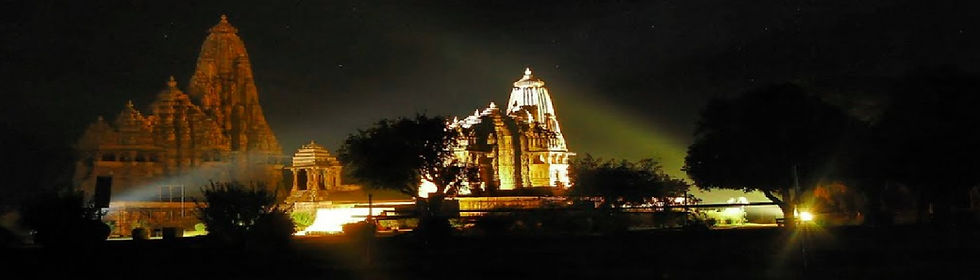
Bring a sneak look into the historical backdrop of Khajuraho and its past decision administration of the Chandelas by going to the sound and light show sorted out by the travel industry division in the nursery of western gathering of sanctuaries. With the voice of Bollywood megastar Amitabh Bachchan playing out of sight, the 50-minute long stable and light show is enlightening just as engaging. For a beginner around, it will fill in as an intensive lesson on the historical backdrop of Khajuraho and the importance of its sanctuaries. The show runs in Hindi and English each night.

3. A less-frequented however commendable site to visit in Khajuraho is the ancestral and society workmanship historical center. It is a serene spot where the metalwork, canvases, earthenware and wooden figures made by the ancestral populace of the area are perfectly put in plain view. Discover it in the Chandela Social Complex.
When To GO KHAJURAHO
Khajuraho is best visited in the monsoon months since hefty downpours between the long periods of June and August render a considerably additionally hypnotizing look to the antiquated sanctuaries and landmarks of this city. From the point of view of solace travel, it is additionally astute to visit the sanctuary city of Madhya Pradesh in winters in light of the fact that the mild sun releases you about touring and other open air exercises easily.
HOW TO REACH
Being a significant traveler place, Khajuraho is very much associated with the remainder of India. Regardless of what your favoured method of movement is, you make certain to arrive at the objective sans any issues. BY AIR Khajuraho has a little however well-useful air terminal that handles airplanes and travelers' to and from significant urban communities like Delhi, Mumbai, Varanasi and Bhopal. The air terminal is found 2 km south of Khajuraho. Travelers originating from unfamiliar nations can get down at either Mumbai or Delhi, and afterward get onto a flight headed for Khajuraho from both of these metros. Neighborhood taxis and taxicabs can be employed from the leave entryway of the Khajuraho Air terminal to arrive at inn or any ideal spot around.
By Street
Khajuraho has transports employing to and from the connecting urban communities like Jhansi, Satna, Chhatarpur, Mahoba, Jabalpur, Bhopal, Indore, Gwalior, Panna, Agra, Allahabad and Varanasi. Vacationer have the choice of boarding either an air conditioner transport or a non-air conditioning one.
By Train Khajuraho has its own railhead which handles around 3000 or more travelers consistently. A great deal of trains likewise end at the railhead in Mahoba, which is situated at 63 km from Khajuraho inside the fringe of Uttar Pradesh. The trains originating from significant Indian urban communities like Mumbai, Delhi, Kolkata, Gwalior, Jabalpur and so on make a refueling break at the railhead in Khajuraho. It is associated by an every day train to New Delhi through Mahoba, Jhansi and Gwalior. In addition, it is likewise associated by a day by day train that ships travelers to and from Agra, Jaipur and Udaipur. A neighborhood train likewise runs in transit to associate Kanpur and Varanasi threefold every week. Obviously, there are taxicabs and auto-carts outside the railroad station to take you around.
Thanku for reading my blog.I hope the given information is helpful for the readers 🙏🙏


Comments